
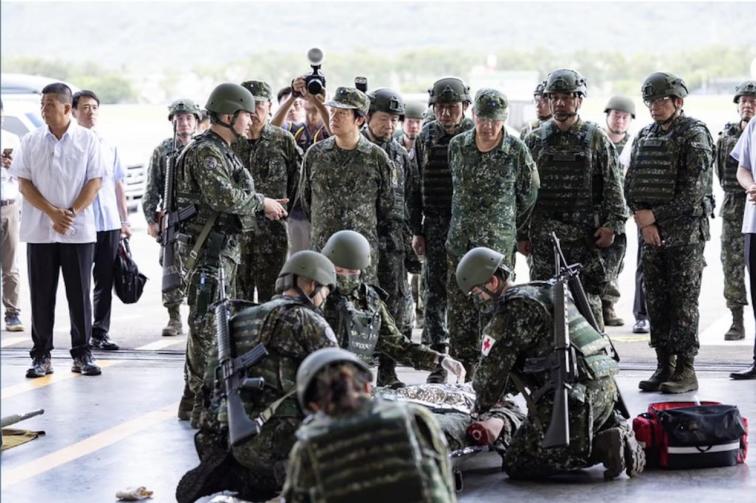
Taiwanese President Lai Ching-te inspecting Air Force combat drills during last year’s Han Kuang exercise. (Taiwan Presidential Office website)
[People News] Venezuelan President Maduro has been captured by the U.S. military and taken to New York for trial. This shocking news has been circulating for three days, but its repercussions are still being felt. The U.S. military's actions have not only dealt a significant blow to Beijing's strategic positioning in Latin America but have also revealed the fragile nature of the CCP's military capabilities when faced with the overwhelming strength of the U.S. military, leaving many mainland 'little pinks' heartbroken. However, under the guidance of the CCP, these 'little pinks' have begun to rally again, claiming that the U.S. military's actions have set a precedent for the CCP to invade Taiwan, even audaciously calling for the "decapitation of the President of the Republic of China, Lai Ching-te." But can the CCP truly be compared to the U.S.? Is Taiwan really in the same situation as Venezuela?
First, let’s consider whether the U.S. capture of Maduro violates international law. This question has been raised by many, particularly by countries that are friendly to Venezuela, especially the CCP, which has issued a so-called strong condemnation of the U.S.
Currently residing in Europe, Du Wen, the former Executive Director of the Legal Advisory Office of the Inner Mongolia Autonomous Region government, conducted a detailed analysis of this issue and arrived at a different conclusion. Mr Du is now a researcher at a United Nations consulting agency and has extensive experience working with EU institutions.
After the U.S. captured Maduro, many friends asked him: Did the U.S. violate international law? Du Wen pointed out that 90% of the questions were misguided from the outset; the question should not be "Is the U.S. being too domineering?" but rather "Who does international law actually protect?"
Du Wen emphasised that international law has never been designed to protect "any regime."
He explained that, according to the United Nations Charter and relevant international law, the focus of international law adjustments is on sovereign states, but a sovereign state is not synonymous with any ruler in power. For a government to be recognised as a legitimate sovereign representative, it must meet at least four minimum criteria: its authority must stem from genuine public opinion; it must have basic internal representativeness; it must fulfil its international obligations; and the state's power must serve the public interest rather than the interests of the ruling group. This represents the legal baseline, not a Western value.
Du Wen believes that the Maduro regime has already reached a state of 'legal bankruptcy.'
He stated that Maduro can no longer be considered a government that exists with public mandate, as the elections in the country have been manipulated, the opposition has been purged, the state machinery serves the ruling group, there is a systematic collapse of human rights, and the functions of the state have disintegrated. Du Wen pointed out that, under international law, this situation is referred to as a factually controlling authority that has lost its legitimacy, rather than a fully recognised 'sovereign government.'
Last year, while seeking a third term, Maduro claimed victory, but the opposition accused the government of electoral fraud. Opposition groups reported that detailed voting results from over 80% of Venezuela's electoral districts indicated that opposition candidate González received 67% of the votes, while Maduro only garnered 30%. At that time, more than ten countries, including the United States, publicly expressed scepticism about the election results and even issued statements declaring that they did not recognise the legitimacy of the election. Notably, China and Russia congratulated Maduro on his re-election.
Thus, Du Wen emphasised that the critical issue lies not in the U.S. 'capture' operation, but in Maduro's 'legal identity.'
If the United States were to overthrow Maduro as the head of state, it would raise issues of sovereignty. However, if he is regarded as a transnational criminal suspect responsible for systematic human rights abuses and as a dictator lacking any representation, then the focus shifts to personal criminal responsibility, aimed at liberating the oppressed and enslaved Venezuelan people, rather than 'violating national sovereignty.'
This means that sovereignty should not serve as a shield for crime and dictatorship. The Venezuelan government is not a legitimate regime, and its leader has come to power through illegal means.
On January 5th, local time, Maduro made his first appearance in the Federal District Court for the Southern District of New York, where he faced charges from the U.S., including conspiracy to commit drug terrorism, conspiracy to smuggle cocaine, possession of machine guns and destructive devices, and conspiracy to possess machine guns and destructive devices against the United States.
These charges indicate that Maduro's status in the U.S. trial is not that of a head of state; he is simply a transnational criminal suspect.
Du Wen remarked that if international law begins to seriously assess whether a regime still holds legitimacy, then those who should be genuinely concerned are Xi Jinping in Beijing, Kim Jong-un in North Korea, the regime in Tehran, Iran, and other illegal dictatorial regimes such as Cuba.
In China, does the CCP regime derive from public opinion? Can the opposition exist legally? Are human rights systematically violated? Does the state machinery serve the people or the ruling elite? The answers are clear. Du Wen emphasised that the current laws of the CCP serve as direct evidence that the CCP is an illegal organisation and an illegitimate regime.
Let’s revisit the initial question: if the United States can capture Maduro, does that imply the Chinese Communist Party (CCP) would dare to eliminate President Lai Ching-te? As of the evening of January 5, this topic has attracted over 650 million views on mainland Weibo. Many 'little pinks' are eagerly discussing: 'If the United States can apprehend individuals in its own backyard, why can't China do the same with Taiwan?'
In response, Taiwanese Democratic Progressive Party (DPP) legislator Shen Bo-yang commented on Threads: 'Some individuals are concerned that the United States has given China a green light, but in reality, dictators do not require a justification to invade. The rationale of 'if you can, then I can too' merely provides an excuse for aggression.'
Bloomberg reported expert analysis indicating that if Xi Jinping were to order an attack on Taiwan, the repercussions could be significantly greater than those of Trump's actions in Venezuela.
Analysts suggest that while the U.S. arrest of the Venezuelan president appears to have incurred no consequences, Beijing's attempt to take Taiwan could lead to extensive sanctions from the West, akin to the Russian invasion of Ukraine, which would severely impact China's economy, already struggling under a real estate bubble. Additionally, Trump's blockade of Venezuelan oil has made Beijing the largest affected buyer. However, obstructing Taiwan's key exports, particularly the world's most advanced chips, would disrupt global supply chains and provoke a more substantial backlash.
Taiwanese DPP legislator Wang Ding-yu stressed to CNN: 'China is not the United States, and Taiwan is not Venezuela. The notion that the CCP could carry out similar actions in Taiwan is both incorrect and inappropriate.' He sharply pointed out: 'The CCP has never lacked military hostility towards Taiwan; what they lack is a viable means to act.'
In reality, the key point is that Xi Jinping likely still recalls Trump’s warning: 'If you attack Taiwan, I will obliterate Beijing.' The recent capture of Maduro further demonstrates that Trump is a man who follows through on his threats. Therefore, does Xi Jinping really have the audacity to recklessly target Lai Ching-te and launch an attack on Taiwan? △






News magazine bootstrap themes!
I like this themes, fast loading and look profesional
Thank you Carlos!
You're welcome!
Please support me with give positive rating!
Yes Sure!